Are Mixes in .wav or .mp3 for Upload
WAV or MP3? This is a question that still causes much confusion. In the sometimes complex earth of digital audio formats, two file types have get the standard. The MP3 and WAV formats are the almost ordinarily used and the nearly widely known. Even if you don't know exactly what they are, chances are you've heard of MP3 & WAV files.
We are taking a look at what they are, how they work, and explaining some of the things, skillful and bad, that brand them different.
What is an MP3 File?
MP3 or MPEG Layer three is a digital audio format developed by the Film Experts Grouping.
The chief goal behind the evolution of MP3 was to replicate CD-quality with no perceivable departure at a much smaller size.
Converting to MP3 compresses an audio file by a cistron of 10 – 12.
What this means is that an audio file of approx. 33 MB would be reduced to approx. 3 MB.
This is done through what is chosen lossy compression, lossy meaning some information is discarded from the original audio.
What is lost is adamant by a process called perceptual or temporal racket shaping.
The bit charge per unit for MP3 files range from 90kbps – 320kbps, the lower the fleck charge per unit, the lower the quality.
What is a WAV File?
A WAV file is a raw sound format created by Microsoft and IBM. This format uses containers to store sound data, sample rates, and bitrates.
They work by taking an audio betoken and converting it to binary data.
An analog to digital converter takes thousands of snapshots per second to capture the full audible frequency range of xx Hz to 20 kHz.
WAV files are lossless and uncompressed which means they lose no quality from the original recording.
WAV files are large and take a lot of infinite.
A stereo, CD-quality recording (44.1 kHz, sixteen scrap) averages around 10 MB per minute.
Increasing to 48 KHz and 24 bit stereo will be reflected in a change from 10 Mb per infinitesimal to 16.48 Mb.
An average three-minute song would crave approx. 33Mb of disk infinite.
That was an overview of what MP3 and WAV files are.
We can now take a closer look at some of the differences between the two.
The biggest deviation is that MP3s are compressed audio and WAV files are uncompressed audio.
Compression, in this context, is the procedure of reducing the size of an audio file.
Lossy Pinch
Every bit I touched on in the overview, lossy compression discards some data from the original recording.
The algorithm makes assumptions on what to discard based on frequencies the human ear is unlikely to detect.
The perceived frequency range that is audible to the human ear is 20 Hz to 20 kHz.
Anything that is unlikely to be detected is filtered out or converted to mono signals to take upwards less space.
While the WAV format represents the full frequency spectrum, MP3 cuts off at effectually 18KHz.
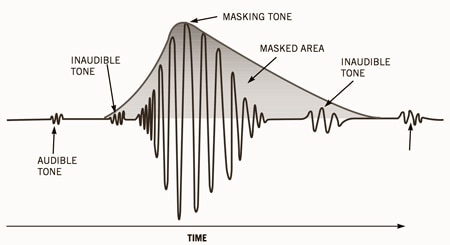
You can see the masking tone creates a wider, masked area.
Sounds that are very quiet and masked by much louder sounds are as well discarded to relieve infinite.
It's highly probable at 128 kbps and to a higher place the average listener wouldn't hear any departure between the compressed and uncompressed audio.
This is what I was referring to earlier when I said "CD Quality sound with no perceivable difference".
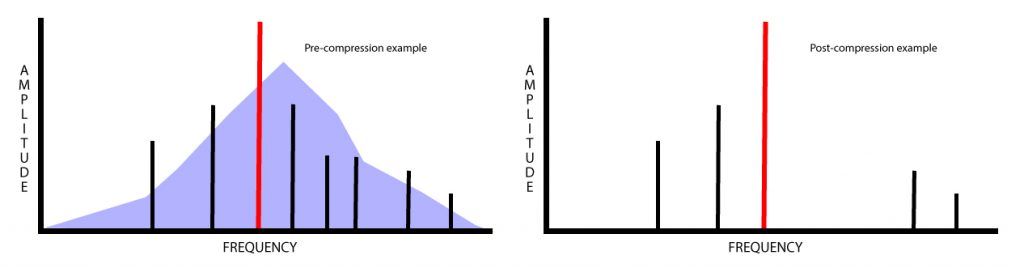
In this uncomplicated diagram, you can clearly come across what'due south missing equally an effect of the masking area post-compression.
Psychoacoustics
The study of how humans perceive sound and a huge part of how lossy compression works.
It is argued that our brains cannot accurately perceive every bit of data that passes our ears when listening to CD-quality audio.
The argument then states that if we don't perceive it equally an audible audio then nosotros don't demand information technology.
In principle, we get the same listening experience but apply a fraction of the disk infinite.
In do, it's however up for argue every bit different audio coding algorithms brand dissimilar choices on what information should be discarded.
Byproducts of Lossy Compression
If leaving out sounds that are unlikely to exist heard anyway sounds expert, in that location is a downside.
Artifacts left behind past lossy compression create unwanted sounds or anomalies that are not in the original recording.
These come in many different forms such as loss of bandwidth, pre-echoes, and post-echoes, double-rails consequence, Dynamics and phase shift and weakened low terminate.
Loss of Bandwidth
Different encoders have unlike perceptual coding algorithms.
This means you tin can't e'er go between platforms and get the same results from the same settings.
A flake rate of 128 kbps or less won't cut it anymore despite existence the standard for platforms like iTunes etc. previously.
Now, at 128 kbps, MP3s filter the college frequencies very crudely, discarding frequency content anywhere above approx. 16 kHz.
The iTunes MP3 encoder goes as far every bit creating distortions in this frequency range and then in lodge to maintain total bandwidth through the iTunes MP3 encoder you must have a bit charge per unit of 256 kbps or higher.
Pre and Post-Echoes
This is when sounds are heard earlier or after the expected sonic upshot.
It's a common artifact in MP3 files and is caused by quantization noise beingness spread over the entire transform-window of the codec.
Temporal masking occurs when a loud sonic event masks a quieter one.
This happens when they occur in shut proximity and it doesn't matter which comes showtime.
Even if the placidity ane happens offset it volition be masked by the louder one if there is simply a small interval of time between the 2.
The masking threshold is the sound pressure level needed to make a sound audible to the homo ear when in the presence of some other sound known equally a masker.
The threshold depends on the frequency, the type of masker and the type of sound beingness masked.
If the sound being masked exists beyond the masking threshold then it becomes audible and nosotros hear it every bit a pre or mail service-echo.
This most often occurs with sounds from percussion instruments but is likely whatever shorter transient burst of noise when encoded to a format such equally MP3.
It's a problem that can occur commonly even at higher bitrates like 256 kbps. In that location is a psychoacoustic element that means one oftentimes hears the pre-repeat merely non the post-echo.
Forward temporal masking is much stronger than astern temporal masking which results in the postal service-echo existence drowned out by the transient.
Double Track Effect
Lower flake rates can sometimes cause audio content timing errors.
The effect of this is about noticeably heard on vocals, creating the illusion of the voice being double-tracked.
Dynamics and Stage Shift
The nature of perceptual audio coding is to remove frequency content that nosotros are unlikely to hear.
The consequence of this tin sometimes mean that our perception of the remaining frequency content tin be altered.
Y'all can finish up with a dynamic range that is massively inconsistent.
Some sounds can seem attenuated which makes surrounding sounds seem additional.
The relative phase or timing of frequency content tin can be changed which can affect stereo imaging or even the transparency and clarity of the material.
When frequency content is stretched over time, like with pre-echoes and post-echoes, information technology can play havoc with the listeners' perception of the audio.
Weak Low End
One of the issues the MP3 format is virtually known for is making a banging bassline audio timid and weak.
Lower frequencies are far more than difficult for DSP (Digital Signal Processing) algorithms to clarify.
This is because lower frequencies have a longer elapsing while the assay windows are short.
This ways that the analysis window won't commonly capture an entire wheel of a low frequency.
In many cases, the encoder will get less than half a cycle of whatever frequency under 114 Hz.
How WAV Files are Encoded
PCM (Pulse Code Modulation) is used for the lossless encoding of audio data.
Information technology is the method used to digitally stand for sampled analog signals.
The amplitude of an analog signal is sampled at uniformed intervals, each sample is and then quantized to the nearest value within a set range of digital steps.
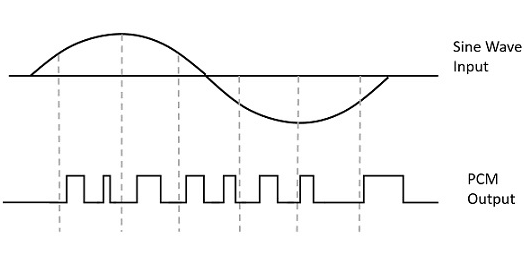
In a PCM stream, the amplitude of the analog bespeak is sampled regularly at compatible intervals, and each sample is quantized to the nearest value within a range of digital steps.
LPCM (Linear Pulse Code Modulation) is a type of PCM where the quantization levels are linearly compatible.
The two basic backdrop that determine the encoded stream's allegiance to the original recording are the sample rate and flake depth.
Sample rate refers to the number of samples that are taken per second.
Chip depth refers to the number of possible digital values that can be used to represent each sample.
PCM is a term more broadly used only often information technology is used to depict data that is encoded as LPCM
A Brief History of the MP3
Karlheinz Brandenburg, a professor at the Fraunhofer Found was one of the lead developers of the MP3.
He was likewise ane of the first people to push for the use of psychoacoustics.
By the late 1980s, the MP3 was almost fix just nevertheless having issues dealing with the human vox.
The song Tom's Diner by Suzanne Vega is a common selection amongst audiophiles for testing audio systems.
The A Capella version of Tom's Diner would besides exist the first runway chosen to test the MP3.
Initially, MP3 compression absolutely destroyed the track leading to hundreds of revisions to go it right.
Ghost in the MP3 is a project by Ryan Mcguire who created a track from the discarded/leftover sounds from Tom'southward Diner afterward pinch.
The MP3 format all the same widely divides stance but whether you think it saved the industry or ruined it, it certainly had a huge effect on it.
In that location were some seminal moments in the history of MP3: the release of the Winamp media player for Windows in 1997 was huge.
In the tardily 1990's I think everyone with a PC created Winamp playlists full of MP3s.
The big modify was that people could now have hundreds of songs on their calculator without filling up their entire hard drive.
Furthermore, people could easily share these songs with others.
This development gave birth to a host of illegal file-sharing platforms.
In 1999 came Napster, the most infamous of the peer2peer sharing platforms which would be caught up in countless legal battles with nigh of the record manufacture.
The next huge development was making this music portable.
The very kickoff MP3 player was the MPman, released in 1998, and and so Apple tree shortly joined the market in 2001 with iTunes and the iPod.
As we all know, the iPod in its various forms took the world past tempest and the MP3 along with it.
When you lot buy music from iTunes it's in the AAC format but you can still convert to MP3 to transfer to compatible devices.
MP3 players have of course been all but forgotten.
Nigh mobile phones now have enough storage for all the music you tin handle. Because of this, MP3s are actually a daily feature in many people'southward lives.
Advantages of MP3
Small File Format
Considering files are so pocket-sized, they can be easily distributed over the Internet and/or huge libraries stored on computers or handheld devices.
Considering of this, they are still widely used today.
Compresses Files with Little Perceivable Departure to the Overall Audio Quality
In most applications, the average listener won't really hear whatever loss in quality
Like shooting fish in a barrel to Convert a WAV or CD to MP3 with Free Software
iTunes, LAME MP3 encoders are many other free converters are available.
Disadvantages of MP3
Degraded Quality
MP3s lossy compression will always mean you sacrifice quality for smaller file size.
Compression Artifacts
Nasty side effects of MP3 compression.
Not Suitable for Professional Piece of work
The loss of quality and the artifacts mean MP3 really doesn't work for professional person piece of work.
Advantages of WAV
Retains full Quality
Information technology is an accurate, lossless format, the quality remains the same as the original recording. Our selection of royalty-free music, for example, is in the lossless WAV format of at least xvi bit/44,i kHz.
Simplicity
Files are piece of cake to edit and process with user-friendly software from freeware to professional applications.
Advancements in Dwelling Recording
Many pop dwelling house studio audio interfaces can at present offering recording rates upwardly to 192 kHz.
WAV is the perfect format to accept reward of this high quality and huge dynamic range.
Disadvantages of WAV
File Size
The large size makes WAV files very impractical for portable devices and streaming.
Quality vs. Size
Despite several advantages and disadvantages for each, the argument over MP3 or WAV will always come up downwards to quality vs. size.
And then, the beginning question is what practice you lot need the file for?
If you are an artist hoping to release a unmarried, virtually online music stores require the WAV format.
When your music is streamed, it'south going to be in some lossy format even if not uploaded as an MP3 file.
An MP3 converted to a WAV volition nonetheless be missing all of the data discarded in the MP3 encoding.
So, don't starting time from a signal where it could only become worse.
Imagine paying a mastering engineer to add the final smoothen then handing over an MP3 to work from.
The bespeak is an MP3 will never be better quality than a WAV under whatsoever circumstances.
When quality is the most of import thing e'er use WAV.
If y'all want to share a demo or idea speedily use MP3.
There are far besides many examples to list but information technology's mutual sense, decide what's more of import, quality or speed and size.
Alternative Formats
FLAC – Free lossless sound codec
FLAC files are lossless and then no quality is lost but they are compressed.
They generally reduce the size of the original sound file by about fifty%.
AIFF – Audio interchange file format
Audio data in AIFF files is uncompressed PCM.
It's some other lossless format and basically the Mac OS version of WAV.
OGG – Ogg Vorbis
A lesser-used or supported the lossy audio format.
OGG files are encoded using a variable bit rate system.
Choosing a quality setting gives the encoder an boilerplate number of $.25 to apply.
When parts of the audio are more difficult to encode extra $.25 will be used.
Source: https://www.audiobuzz.com/blog/wav-or-mp3-whats-the-difference/
0 Response to "Are Mixes in .wav or .mp3 for Upload"
Post a Comment